Report from the ESMINT Congress 18 – September 2–4, Marseille
I attended the congress for the first time in three years and was pleasantly surprised by the breadth and quality of its content. It covered virtually the entire field of interventional neuroradiology (INR), with speakers from all over the world, although the strongest influence came primarily from speakers from the United States.
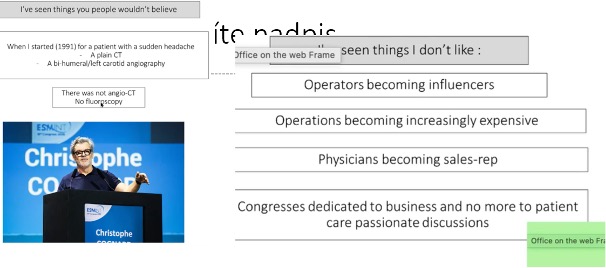
Christoph Cognard receiving an award
Information from the Congress Programme (chronological)
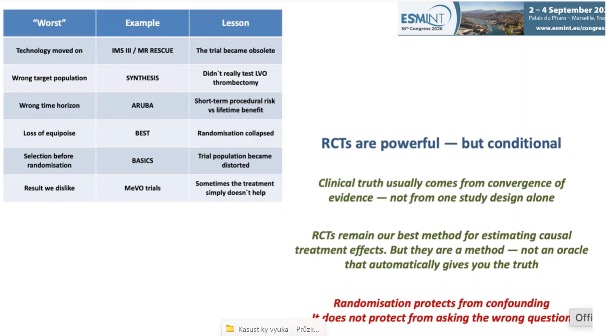
“Bad and good” studies in acute ischemic stroke (AIS)
The study protocols of the MeVO trials were critically discussed, as were the guidelines for endovascular treatment (EVT) in the posterior circulation and the AHA guidelines on distal occlusions issued in January 2026 – see Krajina on VUMEDI.IV thrombolysis (IVT) prior to EVT is beneficial only if administered early. Later, its effect diminishes significantly.
Key messages:
The large-core trials asked not who remains treatable despite time, but who remains treatable despite tissue damage.
Who will watch the watchmen?
Christoph Cognard receiving an award.
EC–IC bypass section, jointly organized with EANS
One presentation focused on recanalization of chronic ICA occlusions. The terms“petrous pattern”and“ophthalmic pattern”should be introduced, depending on the pattern of retrograde flow seen on CTA or DSA. The same terminology is also used in vascular surgery.They presented a series of approximately ten treated patients. The authors consider this approach less risky than EC–IC bypass surgery, which, in their view, should be centralized in only a few highly specialized centers (e.g., Charité).
Treatment of fusiform aneurysms in the posterior circulation with flow diverters (FDs) was also presented as highly effective, with outcomes depending on the length of the affected segment.
Ticagrelor (Brilique)
A major concern was raised regarding interruption of ticagrelor therapy: missing even a single dose may have serious consequences.DAVZ, WISE, INSPIRE
I did not see any major new information. These studies concern endothelial coverage of the inner surface of flow diverters and have already been addressed in published literature.CREST-2
CREST-2 highlighted why the trial produced positive results. CAS cannot be performed by just anyone. Participating operators were required to provide documentation for 10 patients; if they did not meet the required criteria, documentation from an additional 20 patients was required. Patient selection, including compliance, was also emphasized.This section also covered acute tandem occlusions and dissections.
Another important topic was the carotid web. Detailed evaluation on CTA is essential, as most carotid webs are overlooked in routine clinical practice and diagnosed only after recurrent stroke. A relatively straightforward treatment option is stenting.
In this context, optical CT was presented as a method for detailed visualization of stent position.
General Assembly
Discussion of collaboration with IINR and with ESMINT as a partner organization.Pulsatile aspiration in aspiration thrombectomy
A pulsatile aspiration system was presented in which vibration of the embolus disrupts fibrin fibers within the thrombus, facilitating aspiration.The principle was presented and implemented in the Thunderbolt system by Penumbra. This could represent a genuinely new level of technology.
Distal recanalization of resistant emboli
Treatment involves implantation of stent retrievers and intra-arterial infusion of tirofiban or thrombolytic agents. This approach has already been published.Radiation safety
There is an opportunity to participate in the SHIELD-INR study. A prospective randomized study from Korea was also presented.A key message was the importance of shielding during procedures. In addition to other measures, appropriate shielding significantly reduced radiation exposure to both patients and staff.
MMA embolization and headache treatment
In patients with subarachnoid hemorrhage (SAH), intra-arterial anesthetic infusion for headache relief can be performed using a microcatheter, followed by MMA embolization during the same session.Anesthetic infusion is also used in patients with chronic migraine. These approaches have already been published.
Executive Committee (ExComm) meeting
The election results were announced. The three highest-ranking positions within the professional society rotate every three years, meaning that the president does not remain in office for more than three years. This is also the practice in some Czech medical specialty societies. I view this positively.Vision and future directions
A quotation by Berenstein was particularly relevant:“The greatest limitation to development is our imagination.”Chronic subdural hematoma can also be treated by aspirating blood from the hematoma through a micropuncture device and subsequently embolizing the MMA.
Henkes discussed the establishment of a dedicated department integrated with neuroradiology, including an intensive care unit. At the beginning, there must be a“charter”; the founders should behave in a friendly manner, because there will be plenty of time for confrontation later.
Another topic was spontaneous intracranial hypotension: catheterization of the dural sac with the aim of identifying the site of CSF leakage and embolizing it with an acrylic agent.
ICAD
There was one particularly poor presentation by a professor from Thailand—overloaded slides and excessive length. Such presentations were rare, but unfortunately they did occur. At a forum of this level, speakers should present with humility and focus on clear, substantive content.Educational cluster
The educational programme included presentations by graduates of ECMINT, EXMINT, E-Fellow, Observership, andTegus Proctorship.I highly appreciate theESMINT webinars (I nominated Jan-Hendrik Bukha for honorary membership) as well as theJournal of NeuroInterventional Surgery (JNIS).
Venous diseases
The main focus was the treatment ofpulsatile tinnitus and idiopathic intracranial hypertension (IIH) using stents for venous sinus stenoses and diverticula.Pressure-gradient measurements and balloon testing were presented byLariboisière Hospital. An important presentation also addressed the anatomy of the venous system.
Poster presentation
Is it worthwhile to recanalize acute occlusions without collaterals?
Antonin Krajina, Katerina Fuxova, David Rehak, David Brustman, Zdenek Belobradek, Eva Vitkova
Recorded by Prof. MUDr. Antonín Krajina, September 9, 2026

